

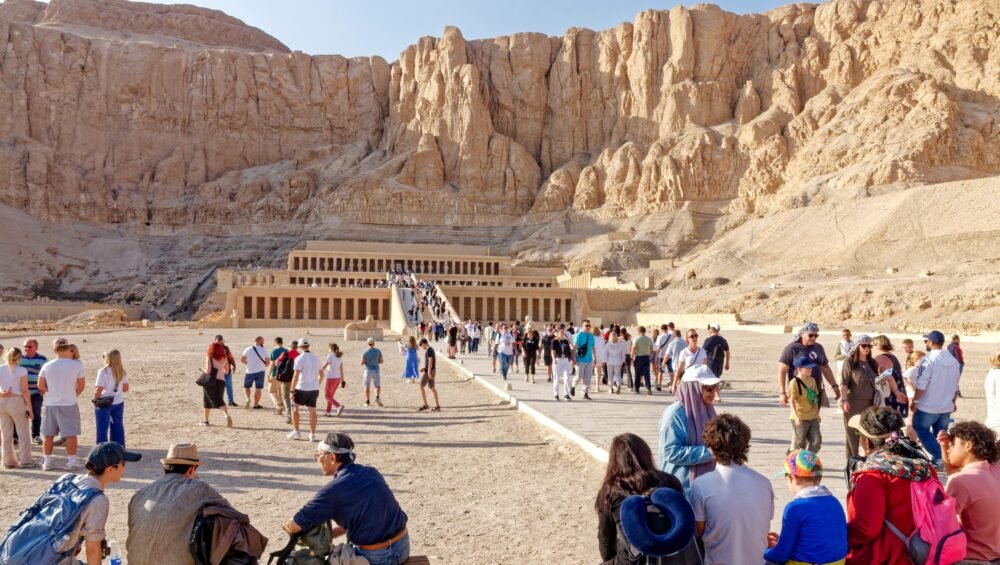
Hatshepsut Temple from Hurghada is more than a photograph of pale terraces beneath a limestone cliff. It is a chance to understand how an Egyptian ruler used architecture, religious imagery and carefully chosen stories to explain her right to govern. At Deir el-Bahari on Luxor’s West Bank, the building rewards visitors who look beyond its famous central ramp: a royal face, a surviving patch of colour or a small carved detail can be as memorable as the whole façade.
This guide concentrates on the temple itself: what its spaces meant, what to look for and how to protect enough time for a satisfying visit. It is not a promise that every decorated room will be open on your date. Conservation work and site management can affect access, so use the historical explanations to ask better questions rather than as a guaranteed room-by-room itinerary.
Planning your journey? Compare the Luxor day trip by bus, small-group minibus trip and two-day Luxor tour. Before booking, ask Hurghada Travels on WhatsApp whether Hatshepsut’s temple is included in the exact itinerary, whether its entrance ticket is covered and how the visit is organised.
Hatshepsut Temple from Hurghada: understand what you are visiting
Start with one important distinction: this is a mortuary temple, not Hatshepsut’s burial chamber. A visitor should not expect to descend into her tomb beneath the terraces. The monument supported royal remembrance and worship, while also giving major roles to Egyptian gods. That difference changes the way you read the site: the open courts, ordered approach and ceremonial imagery belong to a place of ritual, not simply a monumental container for a royal burial.
Hatshepsut ruled as a pharaoh during Egypt’s Eighteenth Dynasty. The Ministry of Tourism and Antiquities dates her kingship to approximately 1473–1458 BCE. Its introduction identifies the temple as Djeser-djeseru and explains its relationship to Amun’s sanctuary at Karnak across the Nile. These are useful anchors for a first visit: a particular ruler, a particular sacred landscape and a building conceived within that landscape, rather than an isolated desert attraction. Read the ministry’s temple introduction for the official overview.
Who was Hatshepsut, and why does her image matter?
Her family connections help make sense of the royal names you may hear at the temple. Hatshepsut was a daughter of Thutmose I and the principal wife of Thutmose II. After his death she acted as regent for the young Thutmose III, then took the full position of pharaoh as his senior co-ruler. This was not simply a queen continuing to act on behalf of a child: it was a change in the office she publicly held. The Met’s account of a Hatshepsut statue traces that progression from royal daughter to wife, regent and ruler.
Before a Hatshepsut Temple from Hurghada trip, it is tempting to reduce the story to “a woman pretending to be a man.” That misses what royal art was designed to do. Egyptian royal representations communicated office, religious legitimacy and continuity. When you see a crown, a formal stance or a beard in a royal image, ask what that combination says about kingship rather than treating it as an ordinary portrait. The aim of a temple image was not the same as the aim of a modern photograph.
On a Hatshepsut Temple from Hurghada visit, ask your guide to distinguish the historical person from the symbolic language used to represent the ruler. Which visible details identify a king? Which identify a god? Is the figure performing an offering, receiving something or standing in an enduring ritual pose? You do not need to read hieroglyphs to notice that these images are structured statements, with gestures and attributes doing much of the work.
Keep certainty and interpretation separate. A guide can explain what an inscription says, but a modern story about a ruler’s private feelings is a different kind of claim. “This scene presents royal legitimacy” is more careful than “this proves exactly what she feared.” The monument is powerful evidence of what was publicly represented; it is not a diary. That distinction makes the historical discussion richer, not less interesting.

Read the three terraces before looking for individual details
The first view is often the strongest, so resist the urge to move immediately towards the highest level. Stand where stopping is permitted and look at how the horizontal terraces answer the vertical cliff behind them. Trace the central approach with your eyes. Notice the repetition of pillars and the relationship between open space and shaded fronts. These simple observations give you a mental plan before the site becomes a sequence of steps and photographs.
A good Hatshepsut Temple from Hurghada experience combines two scales of attention: the enormous composition and the small surviving marks on individual surfaces. If you only take the panoramic view, you miss the stories. If you only chase famous scenes, you lose the reason the building feels so striking. Let each scale explain the other.
| What you notice | What to ask | What it adds to the visit |
|---|---|---|
| The long central alignment | How does the approach direct attention? | A sense of ceremony rather than a random collection of rooms |
| Repeated pillars and terraces | How does repetition change the apparent scale? | A way to understand the façade without specialist vocabulary |
| Small rooms behind a broad exterior | Which spaces held the religious focus? | A reminder that the most photographed surface is not the whole temple |
The lower approach: build your mental map
On arrival at Hatshepsut Temple from Hurghada, use the lower view to orient yourself rather than to identify every feature immediately. Find the central axis, the different terrace levels and the outline of the surrounding basin. Then choose one architectural detail to follow as you move: the spacing of supports, the changing view of the ramp or the contrast between exposed and sheltered surfaces. Following a single detail is often easier than trying to remember a long list of names.
Look back as well as forward, but only from safe stopping places. The view away from the cliff helps explain why the approach matters. Avoid stopping in the middle of a narrow circulation route to recreate an image you saw online. The satisfying photograph is the one that fits the actual conditions of the visit, not the one that requires other people to disappear.
The middle level: slow down for the narrative
The middle part of the temple is especially important for understanding its narrative decoration. Ask your guide to identify the relevant decorated areas from the currently permitted route. Instead of accepting a rapid label such as “Punt” or “birth scene,” request one concrete detail that makes the identification meaningful. A scene becomes easier to remember when you can connect its name to something you have actually seen.
If the group must move on before you have understood a detail, make a short note of the question rather than wandering into a closed area or losing the meeting point. A clear photograph taken where allowed can help you return to the subject later. Good interpretation does not require touching a surface, leaning over a barrier or finding a private angle behind the group.
The upper façade: compare image, rhythm and scale
At the upper façade, notice how sculptural forms interact with the supports. Seen from a distance, repeated figures become part of the architecture; seen closer, their crowns, faces and surviving surfaces invite individual attention. Compare those experiences. Does your eye follow the row, settle on a single figure or return to the cliff? The temple can be read as a composition even before any particular inscription is translated.
The Metropolitan Museum’s architectural discussion is useful preparation: it describes the contrast between the expansive exterior and smaller religious rooms and explains the importance of the Osiride statue programme. Its model photographs are reconstructions for study, not promises about the exact appearance or accessibility of the monument today.

Punt, divine birth and Osiride statues: three stories to recognise
The expedition to Punt: look for a story, not a souvenir label
The Punt reliefs are among the temple’s best-known subjects. They present an expedition and its encounters, goods and surroundings. Treat them as a carefully composed royal account rather than an unfiltered travel report. The interesting question is not only “what came back?” but also “why was this achievement shown here, in this particular ruler’s temple?” The connection between distant resources, successful rule and religious presentation gives the scenes their significance.
During a Hatshepsut Temple from Hurghada visit, ask which part of the Punt narrative can actually be seen from the open route. Let the guide identify a specific surviving feature before you photograph it. Not every relief of a boat, offering or plant is automatically part of the Punt sequence, and a confidently labelled photograph can still be wrong if it was taken in another decorated area.
Be cautious about modern maps that give Punt a precise pin without qualification. The location is a historical question, not a currently bookable destination with a universally agreed street address. For a visitor, understanding the expedition’s role in the temple programme is more useful than memorising an overconfident geographic claim. Ask what the ancient depiction shows and what modern scholarship infers from it.

The divine-birth narrative: understand a claim to legitimacy
Another major narrative presents Hatshepsut’s divine parentage and right to rule. Read it as religious and royal communication. The question to bring to the wall is “how does this scene support kingship?” rather than whether it functions like a modern certificate of birth. The presence and actions of gods belong to the meaning of the narrative, not to incidental decoration around a human story.
Before your guide names every figure, look at how the scene is arranged. Who faces whom? Where does a gesture draw attention? Are the figures separated into registers or linked by a repeated direction of movement? Such questions help you follow an explanation even if several Egyptian names are new. They also stop the experience becoming an exercise in collecting facts that vanish as soon as the coach leaves.

The Osiride figures: the ruler in a religious form
The monumental mummiform figures connect royal representation with Osiris. Their stillness is meaningful: they are not intended as snapshots of someone walking through a courtyard. Look at the relationship between body, crown and architectural support. Then compare the surviving completeness of adjacent figures without assuming that every missing face or broken edge has the same history.
A useful question is “which parts are ancient and which have been reconstructed?” A responsible answer may require pointing to particular joints or explaining that certainty varies by element. Do not judge authenticity simply by whether a block looks clean. A restored monument can preserve important ancient material while also relying on modern work to make its structure legible and safe.

Religious spaces, conservation and the limits of a visitor route
The temple’s religious programme reaches beyond royal commemoration. Amun, Hathor, Anubis and solar worship belong to the broader interpretation of its spaces. Knowing those names is useful; expecting every associated chapel or sanctuary to be open is not. When arranging Hatshepsut Temple from Hurghada, ask the operator to describe the usual public visit, then confirm actual access with the guide and site staff on the day.
Think of a temple plan as an explanation of relationships, not permission to enter every marked room. A central sanctuary, side chapel, offering space and open court had different functions. If access to one space is restricted, a guide can still explain where it sits within the whole. A closed doorway does not make the history irrelevant, but it does change what you can personally inspect.

How to look at surviving colour
Stone monuments are often imagined as uniformly beige because exposed surfaces dominate photographs. Where colour survives, take time to observe it from the permitted viewing position. Notice whether colour helps separate a figure from its background or distinguish one element from another. Do not wet a surface, use your hand to shade it by touching it or assume that a faded patch needs closer physical contact to be understood.
Try one wide image for context and one closer composition if your camera can make it without moving beyond the barrier. A close-up with no surrounding context is difficult to identify afterwards. Keeping the two together helps you remember not just what the detail looked like, but where it belonged. This is especially valuable when several decorated areas have similar-looking figures and inscriptions.

Why the temple looks complete in some places and fragmentary in others
Part of appreciating Hatshepsut Temple from Hurghada is recognising that the standing monument is also the result of archaeological work and conservation. The Met’s account describes successive damage and later rebuilding, and identifies the Polish-Egyptian restoration project working here since 1961. That history is a reason to look closely, not to dismiss the temple as “all rebuilt.” Ancient fragments, reconstructed forms and unresolved gaps can coexist within one view.
Read the Polish-Egyptian expedition’s research information if conservation particularly interests you. On site, avoid turning every damaged figure into a single dramatic story about personal revenge. Damage may belong to different episodes, and an explanation should be attached to evidence. Asking “how do we know?” is one of the best questions you can bring to an archaeological monument.

Plan Hatshepsut Temple from Hurghada around the visit you want
The most useful Hatshepsut Temple from Hurghada booking decision is not simply bus versus minibus. It is whether the day leaves room for the kind of temple visit you want. Someone who mainly wants the architectural panorama has different priorities from a traveller who wants to hear the Punt narrative explained in detail. Tell the operator your priority before paying, especially if this temple is the main reason you are travelling to Luxor.
For Hatshepsut Temple from Hurghada, ask for the confirmed itinerary by name. “Luxor West Bank” is not specific enough: it does not by itself establish which archaeological sites, tomb areas or tickets are included. Likewise, a smaller vehicle does not automatically guarantee a longer temple stop, private guiding or access to a restricted chapel. Compare what is written, not what the vehicle photograph suggests.
| Option | Useful question | Do not assume |
|---|---|---|
| Bus day trip | How is the temple explanation and regrouping organised? | That every bus itinerary includes the same West Bank stops |
| Small-group minibus | How many guests and what guiding language are confirmed? | That “small group” means a private visit |
| Two-day journey | How is time divided between sites on each day? | That an overnight stay automatically adds temple access |
For the wider route, use our Luxor itinerary comparison. If you are deciding whether to spread the journey over two days, read the two-day Luxor planning guide. Those pages handle the overall trip; this guide helps you make the temple portion more rewarding.

Set a realistic interpretation priority
For Hatshepsut Temple from Hurghada, choose three priorities before leaving: the architectural overview, one narrative relief and one sculptural or religious detail. This is a useful personal plan, not a timetable or guaranteed route. If conditions allow more, excellent. If access or pacing is limited, you still have a coherent way to experience the site instead of spending the whole stop worrying about what you have not yet found.
Ask where the guide will explain the monument and where you should meet afterwards. Do not assume explanations take place inside every chapel or that you may remain after the group has left. A precise meeting place is more useful than “near the entrance.” Agree how to contact the guide if you become separated, and keep the relevant information available without relying entirely on mobile reception.

Tickets and opening information: separate entry from your tour fare
The official ticket portal checked on 27 October 2026 lists foreign adult admission at EGP 440 and foreign student admission at EGP 220. These are archaeological-site entry prices, not the cost of transport from Hurghada, a guide, lunch or a complete excursion. The bus and minibus listings linked above currently include standard site admission, so do not add this gate price again when comparing those packages. For any different Hatshepsut Temple from Hurghada quotation, check whether the ticket is included or payable separately.
The same portal lists opening from 06:00, with last entry at 17:00 in summer and 16:00 in winter and Ramadan. Last entry is not a recommended arrival time for an unhurried visit. Seasonal schedules and admission conditions can change: check the official Hatshepsut Temple ticket page again for your travel date rather than relying on an old screenshot.
Student reductions require the portal’s eligibility conditions and valid documentation; do not assume any student card qualifies. Likewise, a child’s attraction-entry concession is not a promise of free transport, a free coach seat or a free tour. Ask for the total booking price using the travellers’ actual ages and request a clear distinction between operator charges and monument admission.
Keep the written inclusion list for Hatshepsut Temple from Hurghada with your booking confirmation. It should make optional additions distinguishable from essentials. If a seller uses “all included,” ask what that means specifically for the temple ticket, transfers from your hotel area, guiding and any optional activities. Clarity before departure is much easier than resolving a misunderstanding while the rest of a group is waiting.
Heat, walking, access and visiting with children
Comfort is part of good interpretation. If you are overheated, thirsty or worried about the walk back, the relief explanation becomes difficult to absorb. Plan Hatshepsut Temple from Hurghada with the long travel day and exposed archaeological setting in mind. Bring drinking water, sun protection and footwear suited to walking; ask about replenishing water and planned breaks rather than assuming every facility will be immediately available where you need it.
Do not confuse a photograph of a ramp with proof of a fully step-free visit. Ask about gradients, surfaces, distances, vehicle drop-off, available assistance and which levels can be reached under current arrangements. If you use a mobility aid, describe it and your transfer requirements before booking. An honest answer about a limited route is more valuable than a general promise that the site is “easy for everyone.”
Our accessible-excursions guide provides questions to send an operator. For this particular temple, request current practical details rather than treating a guide article as an accessibility certification. Shuttle arrangements, toilets and guide access should be confirmed directly; they are not guaranteed here.
Make the visit meaningful for children
When visiting Hatshepsut Temple from Hurghada with children, give them a small observational task rather than a long history lesson: count terrace levels, find a repeated crown shape or compare a complete figure with a fragment. Ask them to describe what they see before supplying the answer. A single memorable observation can create more interest than a rushed list of royal names. Keep the task entirely within the permitted visitor route.
Explain the basic conservation rules before arrival: no climbing, no touching decorated surfaces and no crossing barriers for a photograph. Discuss the journey and rest requirements separately from the temple’s historical appeal. The family Luxor guide helps with the wider decision about whether the day suits your group.

Photograph the temple without losing the experience
A varied Hatshepsut Temple from Hurghada photo set tells a better story than ten nearly identical wide views. Aim for an overall composition, an architectural rhythm, an accurately identified relief detail and a statue study where permitted. Include enough context to remember what each detail represents. Captioning a picture “ancient relief” is better than giving it a precise but incorrect subject.
The official ticket page currently lists mobile photography as free. That does not establish the rules for every camera, tripod, professional shoot or accessory. Ask about your equipment and follow current signs and staff directions. Do not use a drone or specialist setup on the assumption that an ordinary admission ticket authorises it.
For composition, wait for a safe gap rather than blocking circulation. Avoid standing on fragile edges or asking companions to climb for a dramatic angle. A person can help show scale, but make that photograph from a permitted position. Be considerate of other visitors, especially people who need more space or time on a route.
Finally, put the camera away for a few minutes. Follow the façade with your eyes, listen to the explanation and choose one detail you want to remember without a screen. The best Hatshepsut Temple from Hurghada visit leaves you with an understanding of the building, not just proof that you stood in front of it.
Hatshepsut Temple from Hurghada: frequently asked questions
Is Hatshepsut buried inside this temple?
No: this is her mortuary temple, not a visitor-accessible burial chamber beneath the terraces. Its purpose involved royal commemoration and religious worship. Do not confuse a visit here with entering a royal tomb elsewhere on the West Bank.
What should I prioritise if the visit is short?
Start with the three-terrace composition, then ask your guide to identify one narrative scene and one sculptural detail along the permitted route. This creates a meaningful visit without assuming a fixed stop length or access to every chapel.
Does every Luxor trip include Hatshepsut’s temple?
No universal itinerary should be assumed. Check the exact named stops in your booking, not only the words “Luxor” or “West Bank.” Confirm both the visit and the entrance-ticket arrangement in writing.
Is a minibus automatically better for this temple?
Not automatically. A smaller group may appeal to you, but the confirmed schedule, guiding language and visit arrangements matter more than the vehicle label alone. Compare these details before choosing your Hatshepsut Temple from Hurghada trip.
Are all chapels and decorated rooms open?
Do not assume so. Conservation and site management can change the visitor route. Ask your guide what is open on the day, respect barriers and use explanations or published research for spaces you cannot enter.
Can I use the foreign-student entrance price?
Only if you meet the current official eligibility and documentation conditions. Check the ticket portal before travel. A discounted monument ticket does not automatically reduce the operator’s transport or guiding charges.
Is the temple suitable for someone with limited mobility?
That depends on individual needs and current arrangements. Ask specific questions about surfaces, gradients, distances, assistance and accessible levels. A general photograph or a broad “accessible” label is not enough to establish suitability.
Can I take photographs on my phone?
The official portal currently lists mobile photography as free. Follow current restrictions and staff instructions, and ask separately about other equipment. Never cross a barrier or touch a relief to obtain a better photograph.
Should I choose a one-day or two-day trip?
Compare the actual schedules and your tolerance for a long travel day. An overnight itinerary may suit travellers who want a different overall pace, but check how much time it actually allocates to this temple rather than assuming.
Is there a German guide to this visit?
Yes. German-speaking readers can use our Hatschepsut-Tempel ab Hurghada guide. When booking, confirm the guiding language separately from the language of the webpage.
Illustrations show the monument at the time each photograph was taken; they do not guarantee current access. Featured photograph: Photo: Holger Uwe Schmitt / Wikimedia Commons, CC BY-SA 4.0. Resized for web.
Turn the famous view into a rewarding visit
Hatshepsut Temple from Hurghada is most rewarding when preparation stays focused: understand the distinction between temple and tomb, recognise the building’s major stories and confirm the practical arrangements that affect your own group. You do not need to become an Egyptologist before travelling. A few well-chosen questions are enough to turn an impressive façade into a place you can begin to read.
Ask Hurghada Travels about your travel date and hotel, and request a written itinerary with the temple visit, ticket inclusion and guiding language clearly stated. Then arrive ready to look carefully: at the cliff and terraces, at the royal figures and, wherever the permitted route allows, at the small surviving details that make this monument distinctive.